

If you play Wordle, Connections, or other daily browser games, you may have come across the term dles.
“Dles” is an informal name for the growing collection of short, repeatable games and puzzles that offer a new challenge each day. They can involve guessing words, solving logic puzzles, identifying locations, or testing your knowledge of a particular subject.
What began as a wave of Wordle-inspired games has grown into a broad collection of daily challenges about geography, movies, music, sports, video games, mathematics, and much more. This guide explains what dles are, introduces some popular examples, and shows how to organize them into a manageable daily routine.
What are dles?
Dles are daily games that typically provide one new puzzle or challenge every day. The name is commonly associated with the “-dle” ending used by Wordle and many games that followed it. Some directories also expand DLE as “Daily Logic Exercise,” although there is no single universal definition.
Most dles share several characteristics:
- Daily challenges: A new puzzle becomes available on a regular daily schedule.
- Short sessions: Many games can be completed in a few minutes.
- Repeatable gameplay: The basic rules stay familiar while the puzzle changes.
- Shared experiences: Many players receive the same challenge and can compare results.
- Progress tracking: Some games record statistics, completion history, or streaks.
Not every dle follows every convention. Some provide practice modes, multiple puzzles, archives, or challenges that vary between players. The central idea is simply a familiar game that gives you a reason to return tomorrow.
Why are so many daily games inspired by Wordle?
Wordle demonstrated how a small, limited puzzle could become part of a daily routine. Rather than offering endless levels, it gives players a clear challenge and a natural stopping point.
A clear daily objective
You might need to guess one word, identify one country, or solve one logic challenge. Knowing exactly what completion looks like makes daily games convenient for short breaks.
A shared challenge
Many dles give everyone the same puzzle for a particular day. That makes it possible to compare results with friends without playing together in real time.
A reason to return
A new puzzle each day turns playing into a small ritual. Some people maintain an official winning streak, while others simply enjoy completing their favorite games consistently.
Popular types of dles to try
Daily games now cover far more than word guessing. These categories and examples are a useful place to begin.
Word games
Wordle asks you to identify a five-letter word in six guesses. Colored tiles show whether letters are correct, misplaced, or absent.
Connections presents 16 words that must be organized into four groups of four, with each group sharing a hidden relationship.
Strands combines a themed word search with a special word or phrase called the spangram.
Geography games
Worldle asks you to identify a country or territory from its silhouette, then provides distance and direction clues after an incorrect guess.
Globle challenges you to find a mystery country using warmer and cooler geographical feedback on a world map.
Movie and entertainment games
Framed asks players to identify a film from a sequence of still images, revealing additional frames as clues.
Other entertainment dles focus on actors, television, songs, or video game characters.
Semantic and logic games
Contexto asks you to discover a secret word by entering guesses and comparing their semantic similarity rankings rather than matching individual letters.
Games based on your interests
Specialized dles cover professional sports, music, history, mathematics, gaming, science, and many other subjects. If you have a particular hobby, there is a good chance someone has built a daily challenge around it.
A personal favorite is PokeDoku, a daily Pokémon trivia game built around a 3×3 grid. Each square combines a row and column category, and you choose a Pokémon that satisfies both. Because each selection can only be used once, completing all nine cells rewards both franchise knowledge and careful planning.
Where can you find more dles?
Several independent directories collect daily games across many categories:
- DLEs.io: A large directory with categories, lists, and game-discovery features.
- DLES.gg: A broad collection of daily logic exercises and a tool for building a daily-game ritual.
- Dailydles: A curated collection organized by subjects such as words, geography, entertainment, and logic.
Directories change as games appear, move, or shut down, so treat them as discovery tools rather than permanent catalogs. You also do not need to play dozens of games: a small group you genuinely enjoy is usually easier to maintain.
How to organize and track your daily dles
As your collection grows, remembering which games you have played can become surprisingly difficult. Each game lives on its own website, and not all of them provide the same progress or streak features.
A simple checklist can solve the organizational problem:
- Wordle — complete
- Connections — complete
- Worldle — complete
- Framed — not completed
- Contexto — not completed
Some games maintain a winning streak. You can also track a separate participation streak based on whether you played each day, regardless of the result.
For a step-by-step setup, see how to track daily dles and game streaks in one checklist.
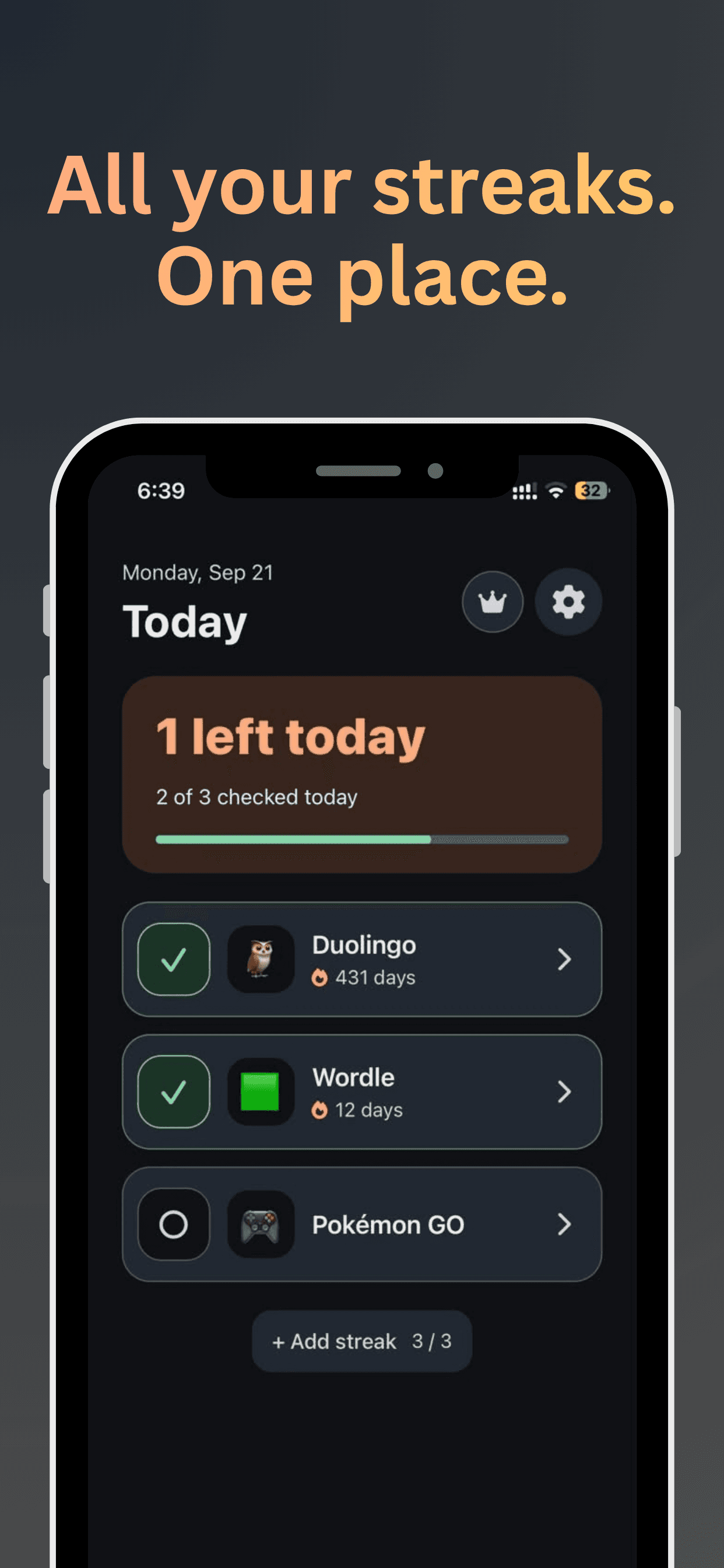
If you prefer to keep everything in one place, Streak Companion is an iPhone app for creating custom streaks, manually checking off completed games, and optionally recording a current count and personal best.
Streak Companion does not connect to or automatically verify activity in third-party games. It provides a simple checklist with optional reminders and Home and Lock Screen widgets.
Final thoughts
Dles have grown from Wordle-inspired puzzles into a diverse collection of daily games covering geography, movies, logic, sports, and countless other interests.
Whether you play one puzzle or maintain a collection of favorites, the appeal is similar: a fresh, manageable challenge to look forward to each day.
For a closer look at that appeal, read why daily games and streaks keep people coming back.
Explore a few games, keep the ones you enjoy, and build a routine that works for you. If you would like one checklist for organizing those games, explore Streak Companion or download it on the App Store.
Streak Companion is independent and is not affiliated with or endorsed by the third-party games, publishers, or services mentioned in this article. Game availability and features may change.